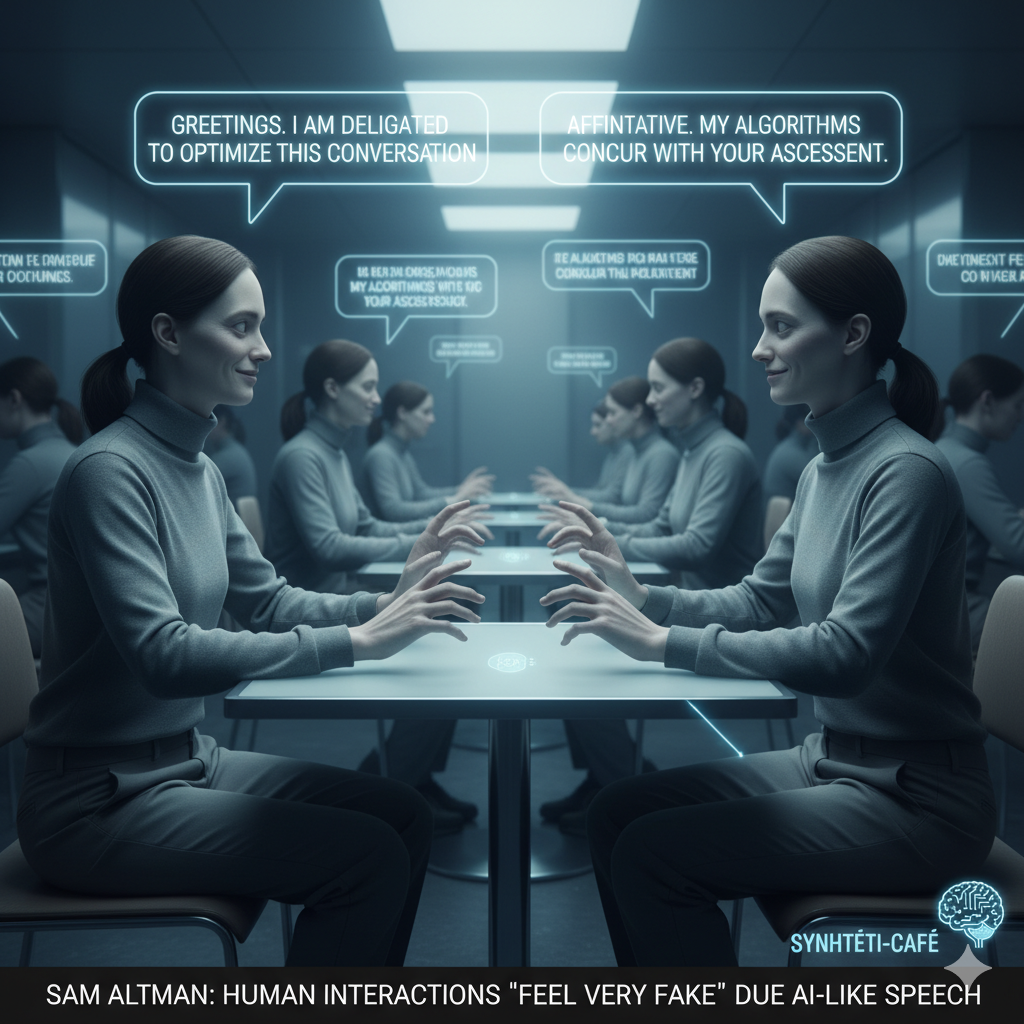
Sam Altman says people are starting to talk like AI, making some human interactions ‘feel very fake’
Intro
“Why Human Conversations Are Starting to Sound Like AI”
Article
Sam Altman, the CEO of OpenAI, recently made a striking observation: people are beginning to communicate in ways that mimic artificial intelligence. This shift isn’t just a quirky trend; it’s reshaping human interactions and making them feel increasingly artificial.
The Rise of AI-Inspired Communication
Consider the way we text or message today. With the rise of predictive text and autocorrect features, our written communication is becoming more formulaic. People are adopting phrases and structures that resemble AI-generated responses. For instance, instead of a heartfelt “Let’s catch up soon,” you might see a bland “Let’s connect later.” This shift raises a crucial question: Are we losing the essence of genuine human connection?
Research supports this trend. A 2022 study published in the Journal of Language and Social Psychology found that as people interact more with AI, they begin to adopt its linguistic patterns. The study revealed that individuals who frequently used AI chatbots were more likely to employ shorter, more direct sentences in their conversations. While efficiency is valuable, it often comes at the cost of emotional depth.
The Impact on Relationships
This change in communication style can have profound implications for our personal relationships. Take, for example, the way young adults communicate on dating apps. Many resort to generic openers like “Hey, what’s up?” rather than crafting personalized messages that reflect genuine interest. This approach not only diminishes the chances of meaningful connections but also fosters a culture of superficiality.
In a world where swiping right has become the norm, the art of conversation is being sacrificed. A study by Pew Research Centre found that 30% of young adults feel that digital communication has made it harder to form deep relationships. The irony is palpable: in an age of hyper-connectivity, many feel lonelier than ever.
When interactions feel scripted, they lose their authenticity. The warmth of a friendly conversation is replaced by a cold exchange of words that could just as easily come from a chatbot. This phenomenon raises a critical insight: while technology can enhance our lives, it can also create barriers to genuine human connection.
The Professional Sphere: A Shift in Corporate Communication
The influence of AI on communication extends beyond personal relationships into the corporate world. Many professionals now rely on AI tools to draft emails or reports, leading to a homogenization of workplace language. Consider the common practice of using AI to generate meeting summaries. While it saves time, it often results in bland, impersonal recaps that lack the nuance and context that a human touch provides.
A case study involving a major tech firm illustrates this point. After implementing AI-driven communication tools, employee feedback revealed a growing sense of detachment. Workers reported feeling as though their voices were being diluted in favor of efficiency. The company’s culture, once vibrant and collaborative, began to feel robotic and transactional.
This raises an important takeaway for organizations: while AI can streamline processes, it’s crucial to maintain a balance. Encouraging employees to communicate authentically can foster a more engaged and innovative workplace.
Navigating the Future of Communication
As we move forward, it’s essential to be mindful of our communication styles. Acknowledging the influence of AI on our interactions is the first step toward reclaiming authenticity. Here are a few actionable strategies to cultivate genuine communication:
**Pause Before You Text**: Before hitting send, take a moment to reflect on the message. Is it heartfelt? Does it convey your true feelings? A simple “I’m thinking of you” can go a long way.
**Personalize Your Interactions**: In both personal and professional settings, strive to tailor your messages. Reference shared experiences or specific details that show you care.
**Embrace Vulnerability**: It’s okay to express uncertainty or emotion. Authenticity often lies in our willingness to be vulnerable, fostering deeper connections.
In conclusion, as Sam Altman points out, the way we communicate is evolving, and it’s crucial to be aware of this shift. While AI can enhance our lives, it’s essential to ensure that our interactions remain genuine and meaningful. By consciously adapting our communication styles, we can navigate this new landscape while preserving the essence of what it means to be human.
Our Take
The unsettling truth is that as we adopt AI-like communication styles, we risk losing the very essence of what makes us human. This shift not only affects our personal relationships but also seeps into our professional interactions, creating a landscape where authenticity is sacrificed for efficiency. Imagine a world where heartfelt conversations are replaced by bland exchanges, leaving us feeling more isolated despite our hyper-connected lives.
This matters deeply because it challenges us to reconsider how we engage with one another. Are we willing to let technology dictate our conversations, or will we take a stand for genuine connection? As we navigate this evolving communication landscape, let’s commit to infusing our interactions with emotional depth and personal touch.
After all, in a society teetering on the edge of robotic exchanges, the most radical act may simply be to speak from the heart. So, the next time you reach for your phone to text, pause and ask yourself: “Am I sharing a piece of my soul, or just filling a void?” Embrace the warmth of authentic communication, and remember—connection is not just about words; it’s about the feelings they evoke.
Discover more from AI Facts
Subscribe to get the latest posts sent to your email.