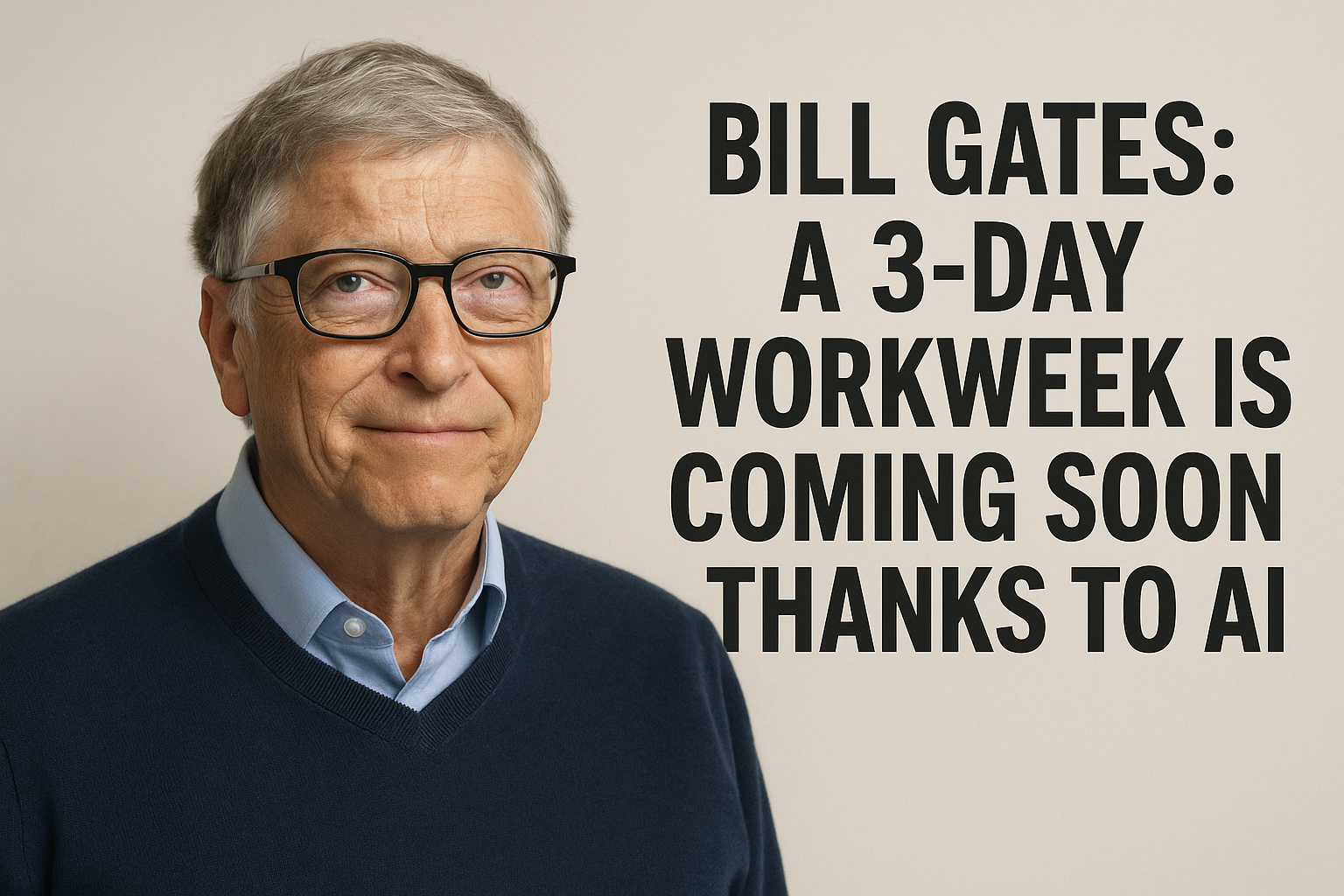
Bill Gates: A 3-day workweek is coming soon thanks to AI
Intro
“Why a 3-Day Workweek Is Closer Than You Think—Thanks to AI!”
Article
Zoom’s CEO agrees with Bill Gates, Jensen Huang, and Jamie Dimon: A 3-day workweek is coming soon thanks to AI
The Future of Work is Shorter
Imagine a world where the traditional five-day workweek becomes a relic of the past. This isn’t just a pipe dream; it’s a vision shared by industry titans like Zoom’s Eric Yuan, Microsoft’s Bill Gates, NVIDIA’s Jensen Huang, and JPMorgan Chase’s Jamie Dimon. They are all pointing toward a future where artificial intelligence (AI) enables a three-day workweek, fundamentally reshaping how we work.
Many might scoff at the idea. After all, the five-day workweek has been the norm for decades. Yet, the rapid advancements in AI are challenging this long-standing convention. With AI capable of automating routine tasks, the potential for increased productivity is staggering. A McKinsey report estimates that up to 30% of the tasks in about 60% of jobs could be automated by 2030. This automation could free employees from mundane tasks, allowing them to focus on more complex, creative, and fulfilling work.
Consider the case of Unilever, which has been experimenting with a four-day workweek in New Zealand. The results? A 20% increase in productivity and a significant boost in employee satisfaction. If a four-day model can yield such impressive results, imagine what a three-day workweek could achieve in an AI-augmented environment. The conversation around work is shifting, and it’s time to rethink how we measure productivity and success.
AI as a Productivity Partner
AI is not just a tool; it’s becoming a partner in the workplace. Companies that embrace AI are discovering that it can handle repetitive tasks, analyze data at lightning speed, and even provide insights that humans might overlook. This shift allows employees to engage in higher-order thinking and strategic planning—activities that are inherently more valuable to organizations.
Take the example of IBM’s Watson. In the healthcare sector, Watson has been used to analyze vast amounts of medical data, assisting doctors in diagnosing diseases more accurately and swiftly. By taking on the heavy lifting of data analysis, AI enables healthcare professionals to spend more time with patients, enhancing the quality of care. If AI can transform healthcare, imagine its potential in other sectors.
The implications for work-life balance are profound. A three-day workweek could lead to happier, healthier employees who are less likely to experience burnout. Companies like Microsoft Japan have already tested a four-day workweek, reporting a 40% boost in productivity. This demonstrates that when employees are given the time to recharge, they return to work more focused and engaged.
Challenging the Status Quo
The idea of a shorter workweek challenges the very fabric of corporate culture. Traditionally, long hours have been equated with dedication and productivity. Yet, research shows that overworked employees are less productive and more prone to mistakes. A study by the World Health Organization found that working long hours can lead to serious health issues, including heart disease and stroke.
As AI takes over more tasks, the need for employees to clock in long hours diminishes. Instead, companies can prioritize outcomes over hours worked. This shift could democratize the workplace, allowing for more flexible arrangements that cater to individual needs.
For instance, Buffer, a social media management platform, has adopted a results-oriented work environment. Employees are evaluated based on their output rather than the number of hours they spend at their desks. This approach not only enhances productivity but also fosters a culture of trust and accountability.
The Unexpected Connection
The push for a three-day workweek isn’t just about productivity; it’s also about redefining success in the workplace. As leaders like Yuan, Gates, Huang, and Dimon advocate for shorter workweeks, they are also calling for a cultural shift that values well-being alongside performance.
The integration of AI into the workforce offers a unique opportunity to reshape our understanding of work. It’s not just about doing more in less time; it’s about creating a sustainable work environment that prioritizes mental health and personal fulfilment.
In a world where technology is increasingly capable of handling routine tasks, the human element becomes even more critical. Employees who are empowered to think creatively and strategically will drive innovation and growth. A three-day workweek could be the catalyst for this transformation, challenging us to rethink what it means to work and succeed in the modern era.
As we stand on the brink of this new paradigm, the question isn’t whether a three-day workweek is possible; it’s whether we’re ready to embrace the changes that AI will bring to our work lives. The future is here, and it’s time to adapt.
Conclusion
A three-day workweek may sound radical, but as AI evolves, it could soon become our new normal. This shift is not just about squeezing more productivity out of fewer days; it’s about redefining our relationship with work itself. Imagine a world where employees are not only more engaged but also healthier and happier—where the hustle culture gives way to a more balanced approach to life.
As leaders like Eric Yuan and Bill Gates advocate for this transformation, we must ask ourselves: Are we ready to let go of outdated notions of productivity tied to long hours? The evidence is clear: companies embracing AI and shorter workweeks report significant boosts in output and employee satisfaction.
The future of work is upon us, and it’s time to seize this opportunity. Let’s not just adapt to change; let’s lead it. As we navigate this exciting landscape, remember: “The goal isn’t just to work less; it’s to live more.” Embracing a three-day workweek could be the key to a more fulfilling and innovative workplace. Are you prepared to champion this change?
Discover more from AI Facts
Subscribe to get the latest posts sent to your email.