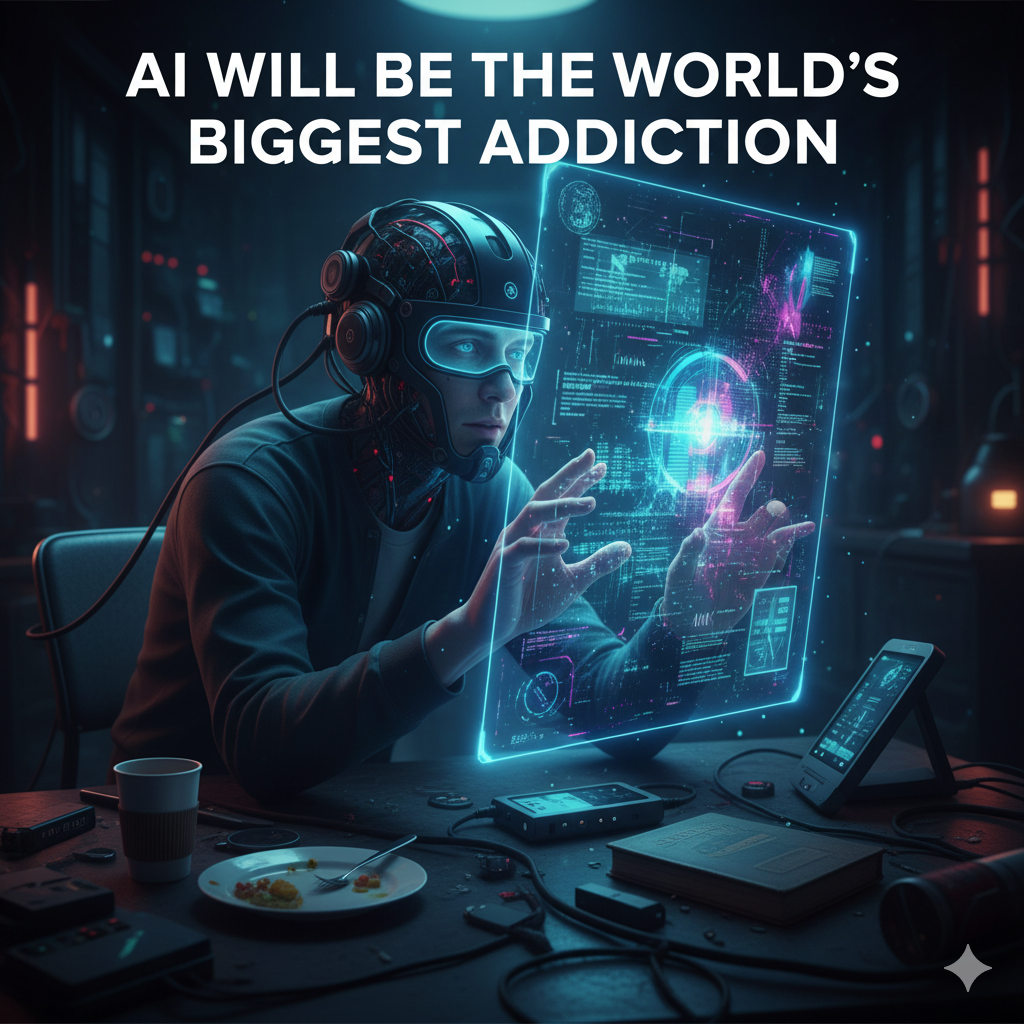
AI will be the worlds biggest addiction
Intro
“The Hidden Truth About AI: The World’s Next Big Addiction”
Article
AI as a Crutch: The Subtle Shift in Our Thinking
AI was designed to assist, to enhance our capabilities. But what happens when that assistance becomes a dependency? The moment we start reaching for AI as a crutch, we enter a cycle that can reshape our cognition and creativity. It’s not just a tool; it’s a facilitator of thought, often at the expense of our own mental processes.
Consider how quickly we’ve integrated AI into our daily lives. A simple text prompt can yield a polished essay or a creative story in seconds. This convenience is alluring, but it comes with a hidden cost. Our reliance on AI can lead to a diminished ability to think critically and independently. The more we lean on it, the more we risk losing our unique voices and perspectives.
The cycle of dependency is insidious. It starts with a single use, then evolves into a habit. Before long, we find ourselves using AI to generate ideas, drafts, and even entire projects. This reliance not only alters our creative processes but also shapes our expectations. We begin to expect instant gratification and polished results, often at the expense of the messy, iterative process that fosters true creativity.
The Profit Motive: Companies Thrive on Dependency
Behind the scenes, the companies that create AI tools have a vested interest in keeping us hooked. The tech giants understand that dependency equals profit. As we become more reliant on their systems, they can monetize our data, refine their algorithms, and create more targeted advertisements. This cycle feeds itself: the more we use AI, the more data they collect, and the better their systems become at predicting our needs and desires.
This isn’t just a theory—it’s a business model. Take, for example, the rise of personalized content feeds on social media platforms. These algorithms are designed to keep us engaged, serving us content that aligns with our preferences. The result? We become more entrenched in our echo chambers, consuming information that reinforces our existing beliefs. This phenomenon isn’t limited to social media; it extends to every aspect of our digital interactions.
The allure of instant answers and validation is powerful. Each notification, each like, serves as a tiny hit of dopamine. This is the same mechanism that drives addiction in other areas of life. The design is intentional: low friction, high reward. As we navigate our digital environments, we’re conditioned to seek out these quick fixes, often at the expense of deeper, more meaningful engagement with our thoughts and ideas.
The Dangers of Conformity: A Homogenized Thought Process
As AI becomes more entrenched in our lives, the risk of homogenization looms large. When everyone leans on the same tools for creativity and problem-solving, we risk losing the diversity of thought that fuels innovation. Writers, artists, and thinkers who rely heavily on AI may find their voices blending into a single, indistinct tone.
Consider the impact on education. Schools are increasingly incorporating AI tools into their curricula, promoting efficiency over depth. While these tools can provide immediate feedback and support, they may inadvertently stifle independent thought. Students raised in this environment could struggle to develop their own ideas and critical thinking skills.
The implications are profound. As our cognitive processes become more aligned with AI outputs, we may see a decline in originality and creativity. The very essence of what makes us human—our ability to think, to question, to innovate—could be at stake.
A Call to Action: Embrace the Slow, Messy Process
So, what can we do to counteract this trend? The answer lies in embracing the slow, often uncomfortable process of independent thought. We must actively resist the urge to reach for AI as a crutch and instead cultivate our own cognitive abilities. This means allowing ourselves the space to think deeply, to struggle with ideas, and to engage with the messy realities of creativity.
Here’s a practical takeaway: set aside dedicated time for brainstorming without AI. Allow yourself to write, think, and create in a low-pressure environment. This practice not only strengthens your mental muscles but also helps you reconnect with your unique voice.
In the end, the challenge is not just about resisting dependency on AI; it’s about redefining our relationship with technology. If we can strike a balance between leveraging AI’s capabilities and nurturing our own creativity, we can mitigate the risks of homogenization and dependency. The future of thought should not be dictated by algorithms but enriched by the diverse perspectives that make us human.
Conclusion
The most unexpected truth about our relationship with AI is that it may not just be a tool but a subtle architect of our thoughts. As we surrender our creative processes to algorithms, we risk not only losing our unique voices but also the very essence of what makes us human. This matters to you—not just as a consumer of technology but as a creator, a thinker, and a decision-maker. The urgency to reclaim our cognitive independence has never been more pressing. Imagine a world where our ideas are shaped not by the uniform outputs of AI but by the rich tapestry of diverse human thought.
So, I challenge you: when was the last time you allowed yourself to wrestle with an idea without the crutch of AI? Make it a habit to set aside time for deep, unassisted thinking. In doing so, you’ll not only sharpen your mind but also rediscover the thrill of true creativity. The future of innovation depends on us daring to embrace the messy, imperfect journey of our own thoughts. Remember, “Our greatest asset is not the technology we wield, but the originality we dare to express.”
Discover more from AI Facts
Subscribe to get the latest posts sent to your email.